
Insurance Claims · Plain English
How auto insurance actually works after a collision.
Right-to-choose-shop, DRPs, supplements, deductibles, rental coverage, total loss. Everything we wish someone had explained to us before our first fender-bender. Written for our customers in San Francisco.
Bottom line: you pick the shop. We handle the rest.
Written by Jack Chew, owner of Lombard Auto Body, 13+ years walking San Francisco customers through body-shop insurance claims on Lombard Street. Reviewed June 2026.
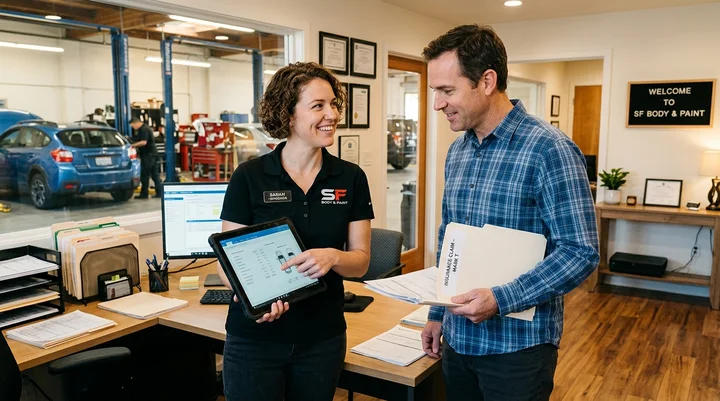
You get to choose the body shop. Always.
Under California Insurance Code §758.5, an insurance company is prohibited from requiring you to use a specific repair shop. They can recommend their preferred shop (their "DRP", Direct Repair Program). They cannot require it. And they cannot reduce your payout, raise your deductible, or void coverage because you chose somewhere else.
If an adjuster pressures you to use their DRP shop, that's steering, and it's against the law. Polite firmness usually ends the conversation: "I appreciate the recommendation. I've chosen Lombard Auto Body. Please send the authorization there."
For the source language, the California Department of Insurance has a consumer-rights page on auto body repair worth bookmarking: CDI auto-insurance consumer guides. The California Bureau of Automotive Repair (BAR), the state agency that licenses body shops, also lays out your repair rights and the complaint process if a shop or a carrier crosses the line.
DRP shop vs non-DRP shop: the trade-offs
Both are legitimate. Different trade-offs. Here's what the insurer's not going to volunteer.
DRP shops
What they're good at: speed of authorization, simplified billing for the carrier, fewer phone calls for you in the first 48 hours.
What they trade off: they operate under cost-saving agreements with the carrier. Aftermarket parts default. Tighter "repair-vs-replace" ratios. The shop has a financial relationship with the insurer that gets renewed annually based on cost control, not your repair outcome.
Non-DRP independents (us)
What we're good at: negotiating each estimate on its own merits, no carrier-imposed parts substitution, OEM parts whenever you want them, full advocacy for the supplement when hidden damage shows up.
What we trade off: authorization sometimes takes an extra day or two on the front end because the adjuster has to actually read our estimate instead of rubber-stamping a pre-negotiated template. We think the trade is worth it. Your call.
The insurance vocabulary you'll hear
These are the words the adjuster will use. Quick definitions so you don't have to ask twice.
- Claim number
- Your file with the insurer. Goes on every document, every phone call, every estimate. You get it when you file.
- Adjuster
- The carrier's representative who reviews your damage, authorizes the repair, and approves supplements. Some are in-house, some are independent contractors who handle claims for multiple carriers.
- Estimate
- The line-item document showing what work is needed, what parts cost, and what labor costs. We write yours in the same software your insurer uses, typically CCC, Mitchell, or Audatex.
- Supplement
- An addition to the original estimate, filed when hidden damage shows up at teardown. Almost every collision repair has at least one. Approval usually takes 1–3 business days.
- Deductible
- The portion of repair cost you pay out of pocket. Paid to the shop at pickup, not at drop-off. The insurer pays the rest directly.
- Total loss / ACV
- When repair cost exceeds a threshold (~70–80% in California) of the car's actual cash value (ACV), the carrier pays the ACV instead of authorizing repair. You can dispute a low valuation.
- Rental reimbursement
- Coverage on your policy that pays for a rental car while yours is in the shop for a covered loss. Daily cap and total-day cap apply.
- Steering
- When an insurer pressures you to use their DRP shop instead of the one you chose. Against California law. Polite firmness ends the conversation.
Common insurance questions before you bring the car in
Does my insurance company decide which body shop I have to use?
What is a DRP shop and is it different from a non-DRP shop?
Will using a non-DRP shop cost me more out of pocket?
What is a "supplement" and why does it matter?
When do I pay my deductible?
Will an insurance claim raise my premium?
How does rental car coverage work?
What if my car is declared a total loss?
Got a claim number and a damaged car?
Bring the claim number to 2340 Lombard St for a free written estimate, or call (415) 292-2962 first if you have questions.